Eden Keller · 4 September 2026
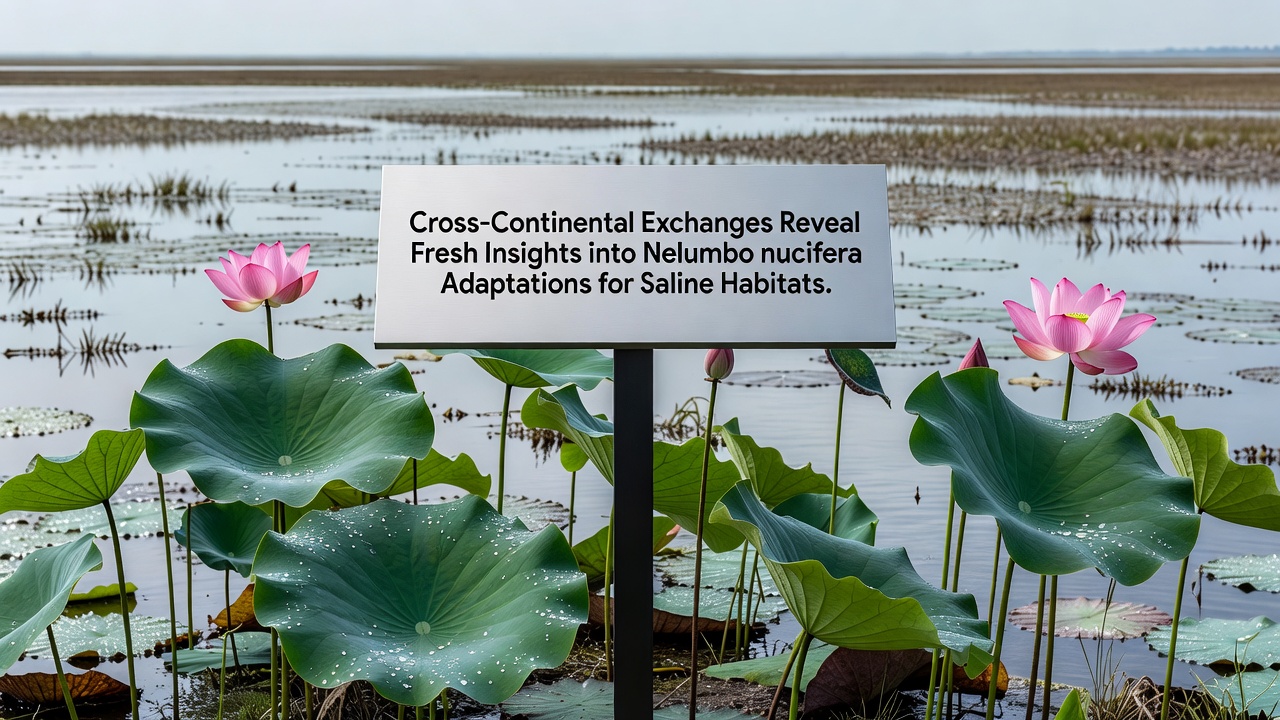
Cross-Continental Exchanges Reveal Fresh Insights into Nelumbo nucifera Adaptations for Saline Habitats
Cross-continental exchanges among botanists and geneticists have uncovered detailed mechanisms that allow Nelumbo nucifera to tolerate saline conditions, a trait once considered rare in this freshwater species. Researchers from Asia, Europe, and North America have shared germplasm collections, sequencing data, and field measurements that highlight specific physiological and genetic responses to elevated salt levels in soil and water. These collaborations have produced datasets showing how certain lotus populations maintain photosynthetic efficiency and root function when exposed to sodium chloride concentrations that typically inhibit growth in standard varieties.
Historical Context of Saline Tolerance Research
Nelumbo nucifera grows across wetlands in temperate and tropical zones, yet documented populations near coastal estuaries in eastern China and parts of India have long demonstrated survival in brackish environments. Early observations from the 1990s noted thicker cuticle layers and altered stomatal density in these plants compared with inland specimens. Data collected through joint projects now link those morphological traits to underlying gene expression patterns that regulate sodium ion exclusion and compartmentalization within vacuoles. Scientists working across institutions have cross-referenced herbarium records with modern genomic tools to trace lineage-specific adaptations that emerged over centuries of exposure to tidal influences.
Key Findings from Shared Genetic Resources
Joint analysis of transcriptomes from multiple accessions has identified upregulated pathways for osmoprotectant synthesis, including glycine betaine and proline accumulation, that stabilize cellular structures under salt stress. One study coordinated between laboratories in Wuhan and Wageningen mapped quantitative trait loci associated with root elongation rates in saline hydroponic systems. Results indicate that certain alleles enhance potassium-sodium selectivity ratios, allowing plants to preserve essential ion balance while limiting toxic uptake. Field trials conducted in replicated plots across different climate zones have confirmed that these genetic markers correlate with higher biomass retention after prolonged exposure to 150 millimolar sodium chloride solutions.
Physiological Adaptations Documented Through International Trials
Measurements taken during synchronized experiments reveal that adapted Nelumbo nucifera lines increase aquaporin activity in root tissues to maintain water uptake despite osmotic gradients created by salt. Leaf tissue analyses further show elevated activity of antioxidant enzymes such as superoxide dismutase and catalase, which mitigate oxidative damage triggered by salinity. Researchers note that these responses vary by developmental stage, with seedlings displaying stronger exclusion mechanisms than mature plants, a pattern observed consistently across test sites in both subtropical and temperate regions.

Additional data from controlled environment chambers demonstrate that stomatal conductance remains stable longer in tolerant lines, supporting continued carbon fixation even as soil conductivity rises. These observations build on earlier single-region reports and now incorporate multi-year datasets that account for seasonal fluctuations in salinity driven by rainfall patterns and tidal cycles.
Role of Collaborative Networks in Accelerating Discoveries
International workshops held since 2023 have facilitated direct exchange of seed materials and standardized phenotyping protocols, reducing duplication of effort and enabling meta-analyses across broader environmental gradients. In September 2026, a scheduled symposium at the International Society for Plant Molecular Biology meeting will present integrated models that combine genomic, proteomic, and metabolomic layers to predict performance under projected sea-level rise scenarios. Such models draw on contributions from teams monitoring natural populations in the Mekong Delta alongside experimental plots in the Netherlands and the Chesapeake Bay region.
Funding streams from national science agencies have supported travel and shared sequencing runs, producing open-access repositories that catalog variant frequencies in candidate genes. These resources allow independent groups to validate findings without repeating initial collection efforts, accelerating the identification of breeding targets for improved salt resilience.
Applications and Future Research Directions
Insights gained through these exchanges inform selection programs aimed at developing lotus cultivars suitable for marginal lands affected by salinization. Agricultural extension services in several countries have begun evaluating elite lines for integration into rice-lotus rotation systems where soil salinity limits conventional cropping. Parallel ecological studies examine how restored populations might stabilize shorelines while providing habitat for wetland species. Continued sampling across additional continents, including Australia and parts of Africa, will test whether similar adaptive strategies have evolved independently or through historical human-mediated dispersal.
Conclusion
Cross-continental data sharing has transformed understanding of Nelumbo nucifera responses to saline habitats by revealing coordinated genetic and physiological adjustments that support survival and growth. Ongoing projects continue to refine these models with expanded geographic coverage and higher-resolution molecular tools, providing a foundation for both conservation strategies and practical cultivation in changing coastal environments.